


 Flare
 PHP
 JavaScript
 Protocol
Working with errors
When an error occurs, Flare receives the exact moment it happened, called an occurrence. When the same error happens multiple times, Flare groups these occurrences together as an error, giving you a single error with insights into how it happens across different users, environments, or circumstances.
Viewing all errors
Every error that gets processed by Flare will be displayed in a list in the Flare project you configured for it. By default, we show the latest unresolved errors.
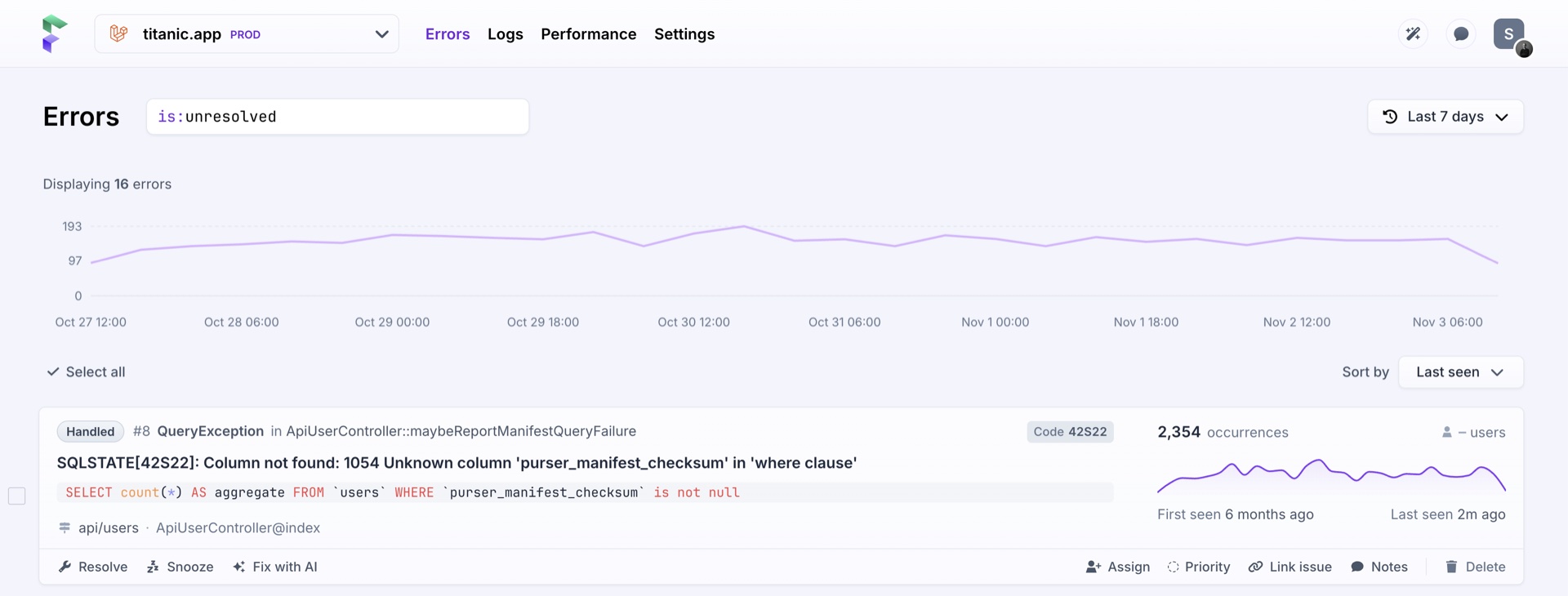
You can use powerful search operators to filter and find specific errors, or filter the list to show only resolved errors or a specific type.
Each error shows an icon for where it came from: a web request, a command or a queued job.
Viewing a single error
Clicking on an error will display a page containing all information Flare has about the error and its occurrences.
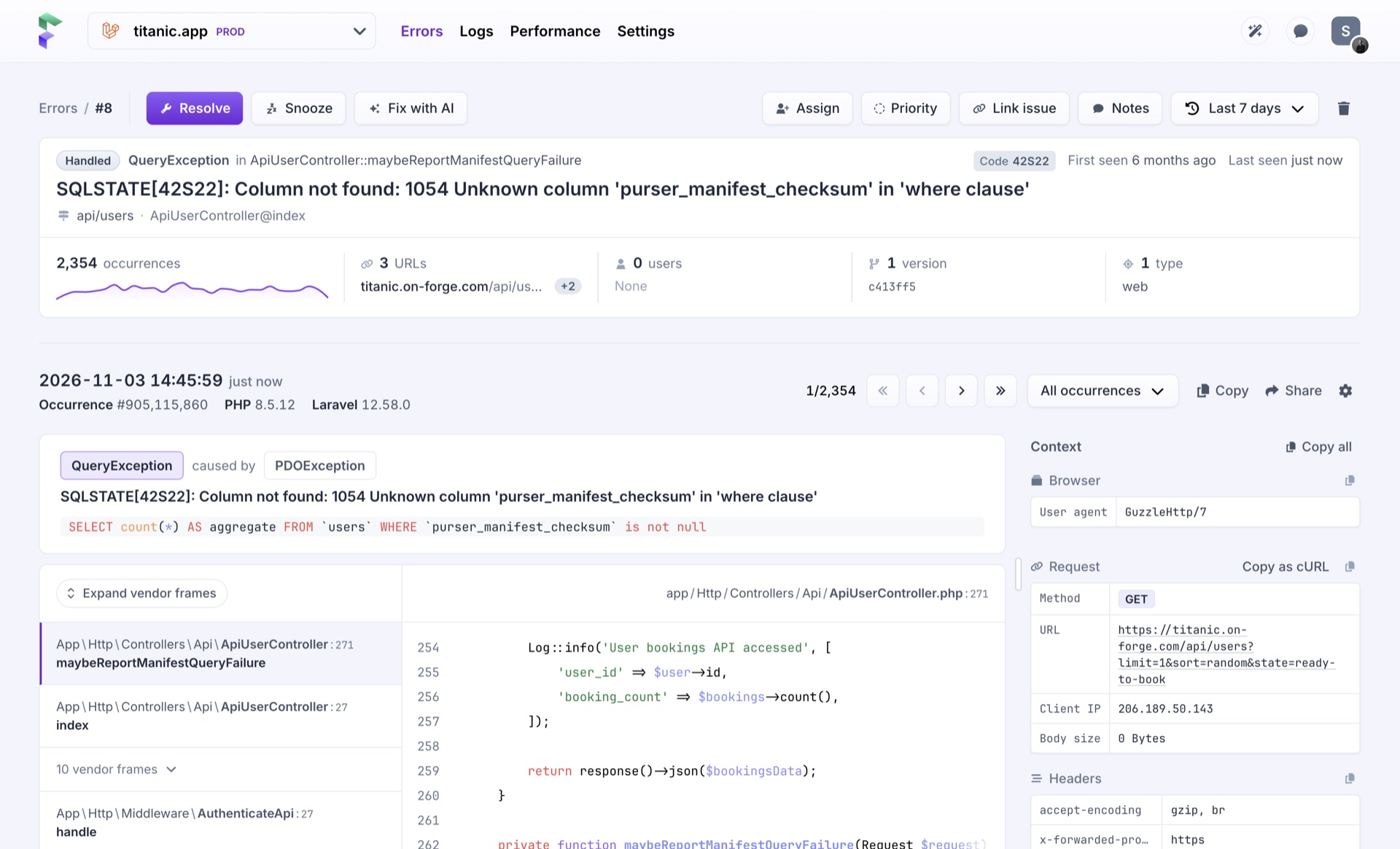
Each error page follows a consistent structure:
- Information about the error, with actions you can perform
- Aggregated insights like affected URLs, users, and versions you can filter on
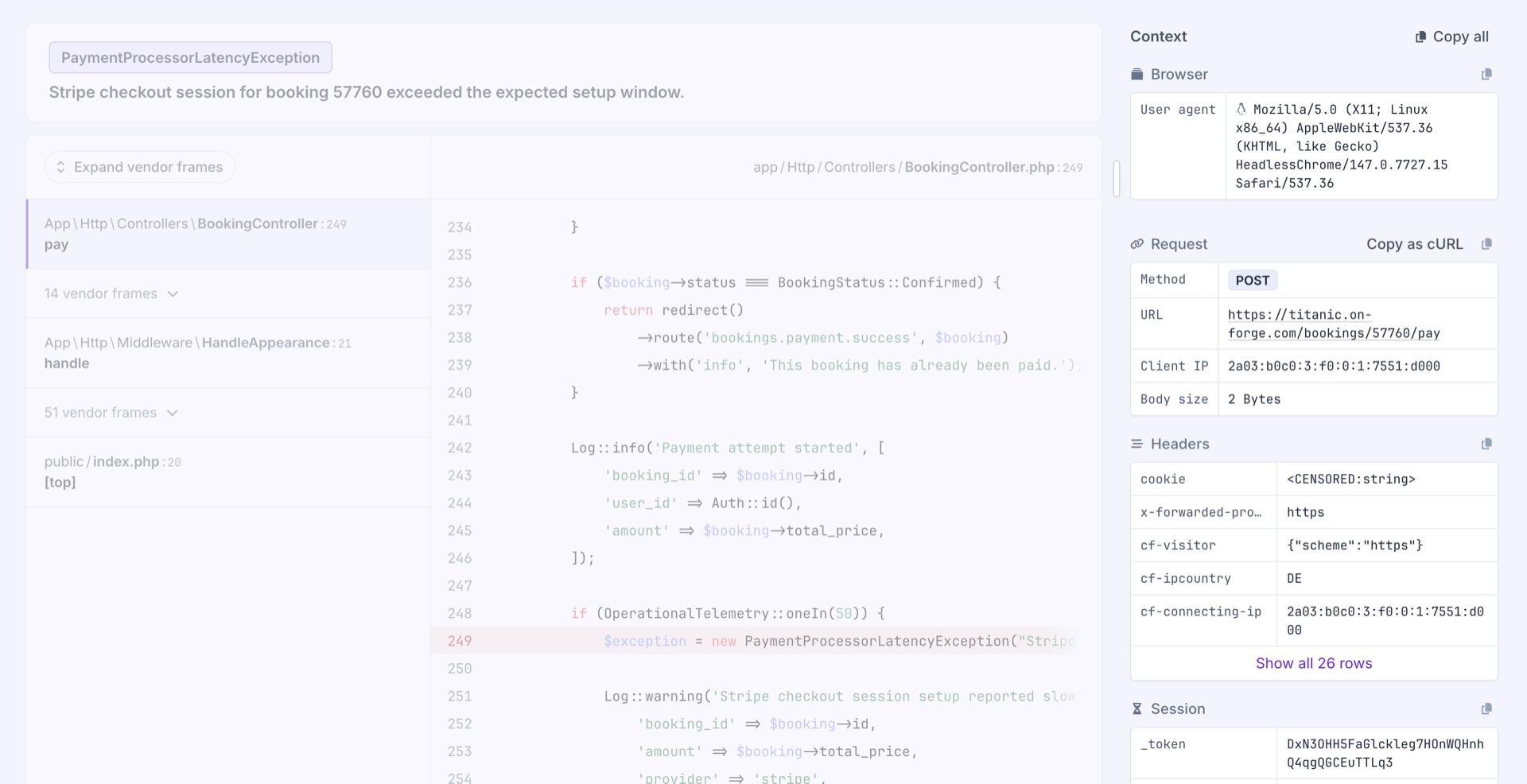
- The latest occurrence, with a stack trace and context
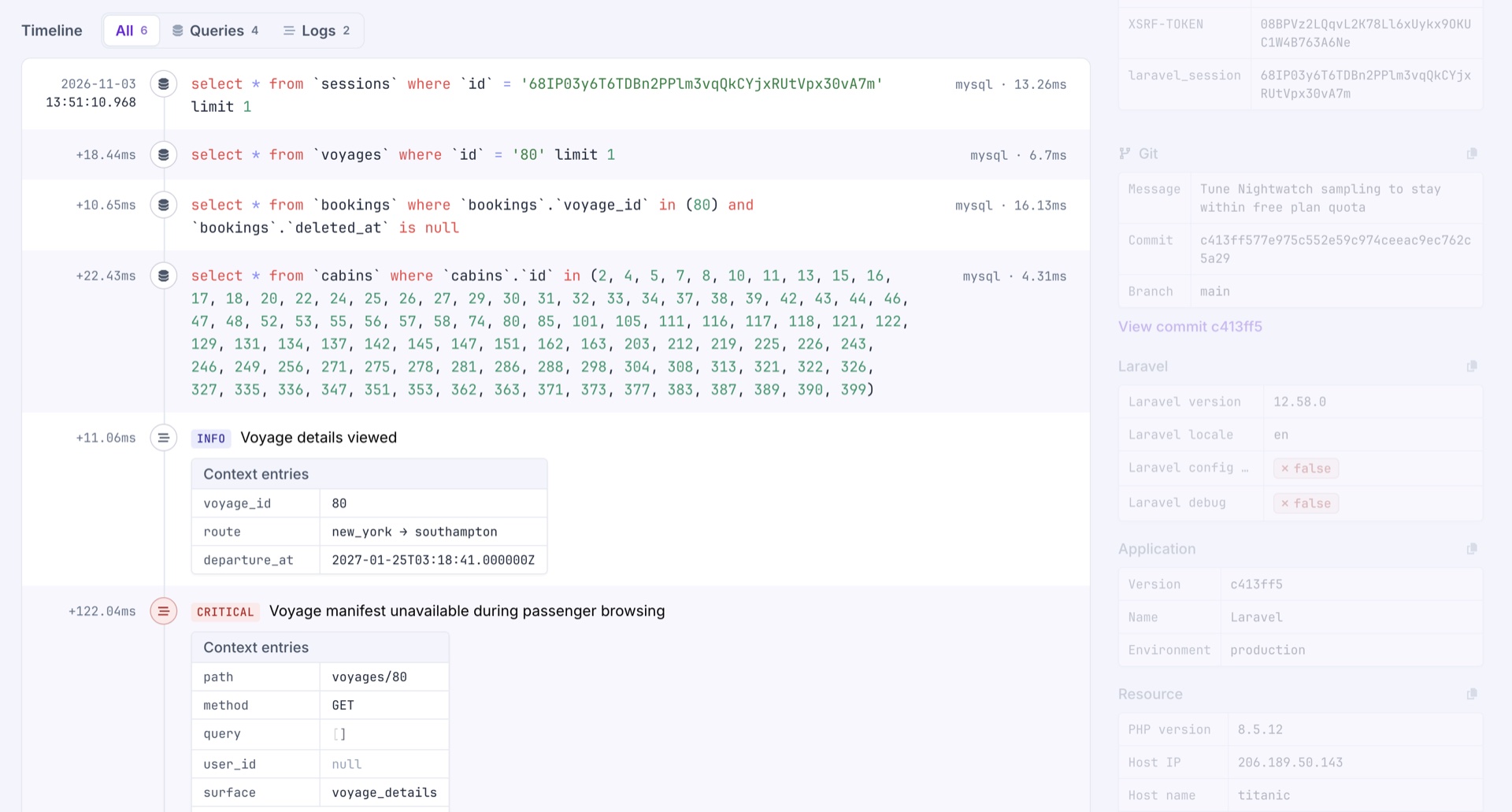
- A timeline listing queries, commands, or jobs that were running when the occurrence triggered an error
Insights
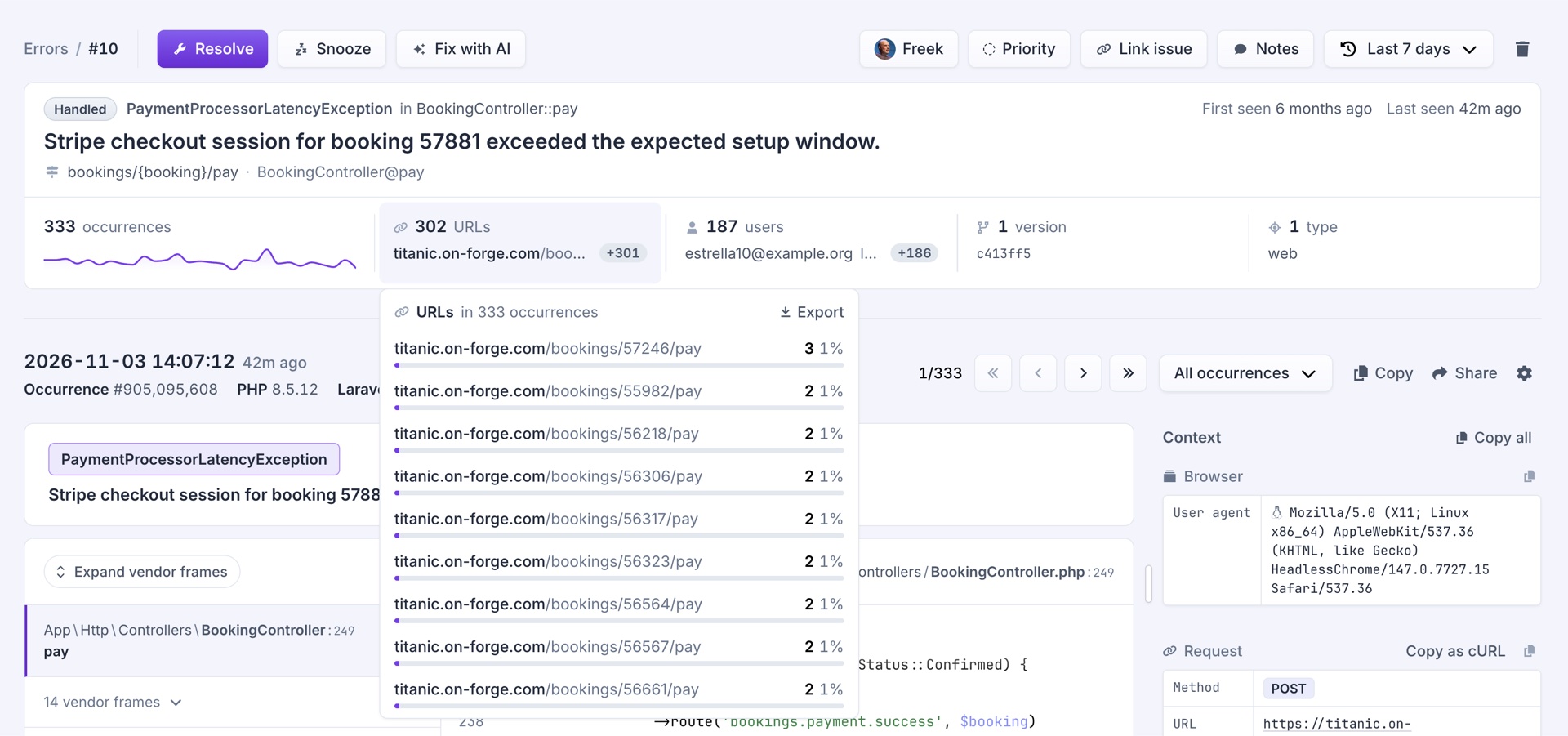
Insights combine all occurrences of an error to show where and how it happened, and which users were affected. By clicking on a specific insight, you will get a list of actual URLs, users, or versions to filter your occurrences by.
| Insight | Description |
|---|---|
| URLs | For errors coming from a URL, route, or page on your website or app, Flare shows a URLs insight, listing all unique URLs where the error occurred. |
| Jobs | If you're using Laravel and a job fails, you'll see a Jobs insight listing all unique jobs in which the error occurred. |
| Commands | If your app throws an error while running a command, you'll see a Commands insight showing all unique commands where that error occurred. |
| Users | A Users insight shows all unique users who encountered the error. |
| Versions | A Versions insight lists all unique release numbers where the error occurred. You can define the release version using the determineVersionUsing function. |
| Type | The Type insight shows all origins or entry points from which the error was triggered. These can be web (for web requests), cli (for commands), or jobs. |
Occurrence & stack trace
Flare will show you the most recent occurrence by default when you open an error. It includes:
- The full stack trace, showing where and how the error happened
- Additional context, depending on the technology and data sent with the event
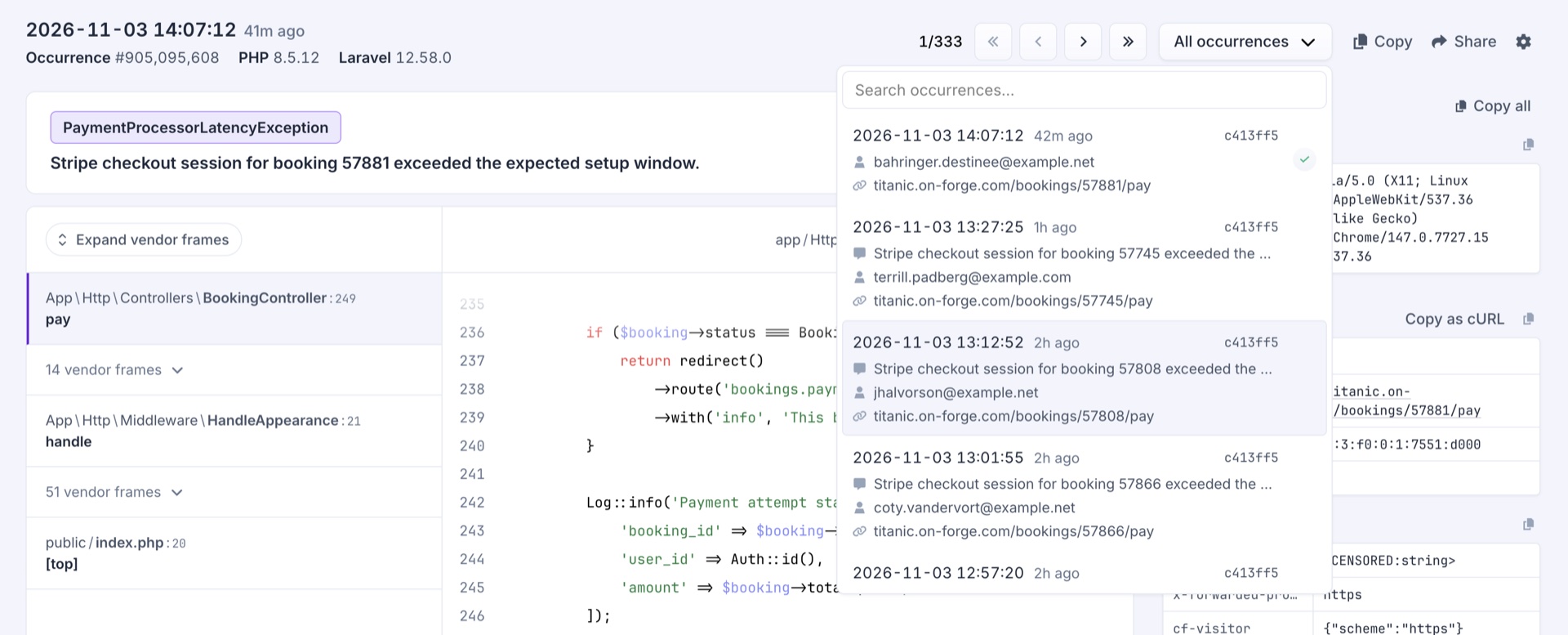
Navigate to older occurrences using the arrows, or click the 'All occurrences' button to see a list of all occurrences that happened, sorted by newest first. You can even search for specific URLs or messages.
The stack trace shows you exactly which line or file triggered the error. If you use PHP, Laravel, or other frameworks and languages, you will probably be familiar with this.
Context
Most occurrences give you basic information about the browser, request, and cookies set by the user who triggered the error. Depending on the technology, type of error, and what caused it, more information can be visible.
For example, if you use Laravel, you'll find a lot of additional information, including logged-in users, queries performed, middleware used, views rendered, the state of any Livewire components, and more.
Timeline
The timeline lists all queries, commands, or jobs that were running when the occurrence triggered an error. You can use filters to toggle event types on or off, which makes busy timelines easier to read.
Actions available on errors
You can perform actions on errors from both the list and the detail page. In the list, you can also select multiple errors and perform actions on them at once.
Click Select all to select every error that matches your current search and time range. This includes the errors on all pages, not only the errors on your screen. Resolve, unresolve, snooze, unsnooze and delete then apply to all of these errors.

| Action | Description |
|---|---|
| Resolve | Once you have fixed an error, you can mark it as resolved. You can optionally enter a comment before you resolve it. Resolved errors will no longer be visible in the default view, which only shows unresolved errors. If a resolved error occurs again, Flare marks it as unresolved and it reappears. To view all resolved errors, remove the is:unresolved filter from the search box at the top, or change the filter to is:resolved. |
| Snooze | If you (temporarily) don't want to receive notifications about an error, you can snooze it for a set time period, a number of times, or for a specific deployment. |
| Fix with AI | Flare generates a few prompts for you to copy and paste into your agent of choice to help you fix the error. You can also use our MCP server to connect your agent directly to Flare and refer to the error from your CLI. |
| Assign | You can assign any error to one of your team members to let them know that they are now responsible for it. Team members who are assigned errors also receive a notification for it on their account. |
| Priority | You can set a priority for each error to indicate to yourself or your team how urgent it is to fix the error. Priorities are only a visual change and do not affect how the error is received. |
| Notes | Use notes to comment on an error or any activity within it. Clicking the Notes button shows all notes left by your team members, as well as any recent activity. |
| Delete | You can delete an error to remove both the entry and the data associated with it. This action cannot be undone. Only team owners and admins can delete errors. |
| Share | If you have an issue tracker (like GitHub, Jira, GitLab, or Linear) linked to Flare, you will have options to create an issue from Flare or sync information from Flare to the issue tracker. |